
In 2026 the model is rarely what takes an agent down. Orchestration and control are. Here are the five patterns that fail most often, and how to fix each.
Capability is not your problem
Every agent workflow that ruins a production weekend started as a clean demo. Someone wires three steps together in a notebook, feeds it a tidy input, watches the model do something impressive, and ships it behind a webhook. Three weeks later the first incident lands: a tool call hangs, a loop runs away, a channel fills with duplicates, and a human kills the process by hand. The fix is almost never a better model. What breaks is the orchestration layer that was never built, and the control that was never wired in.
| Anti-pattern | Warning sign | The fix |
|---|---|---|
| A swarm when one agent would do | Infinite A→B→C handoffs, ballooning latency and cost | Start with one agent; add agents only for a named, better decision |
| Handing over too many keys | Broad standing access; a hallucination becomes a breach | Least privilege; short-lived, human-approved permissions |
| No budget, no brakes | Runaway loops; costs that spike at scale | Hard step, token and cost limits; timeouts; idempotency |
| Shipping the demo, not the infrastructure | Silent failures; no way to reproduce what happened | Tracing, observability and safe retries from day one |
| Autonomy where a human belongs | Irreversible actions taken unsupervised | Match autonomy to consequence; approval gate on irreversible steps |
1. Reaching for a swarm when one agent would do
The instinct to decompose every problem into a team of specialist agents is the most common over-engineering mistake we see. Multi-agent systems add coordination surface, latency, and cost, and they introduce a signature failure mode: the infinite handoff. Start with one agent and a clear tool set, and add agents only when you can name the specific decision a separate agent makes better.
2. Handing an agent more keys than it needs
An agent is an actor with credentials. When you give it broad, standing access to tools and data, a single hallucination stops being a wrong answer and becomes a privilege-escalation incident. Nearly half of security professionals now rank agentic AI as their top emerging attack vector for the year. Apply least privilege literally.
3. Shipping an agent with no budget and no brakes
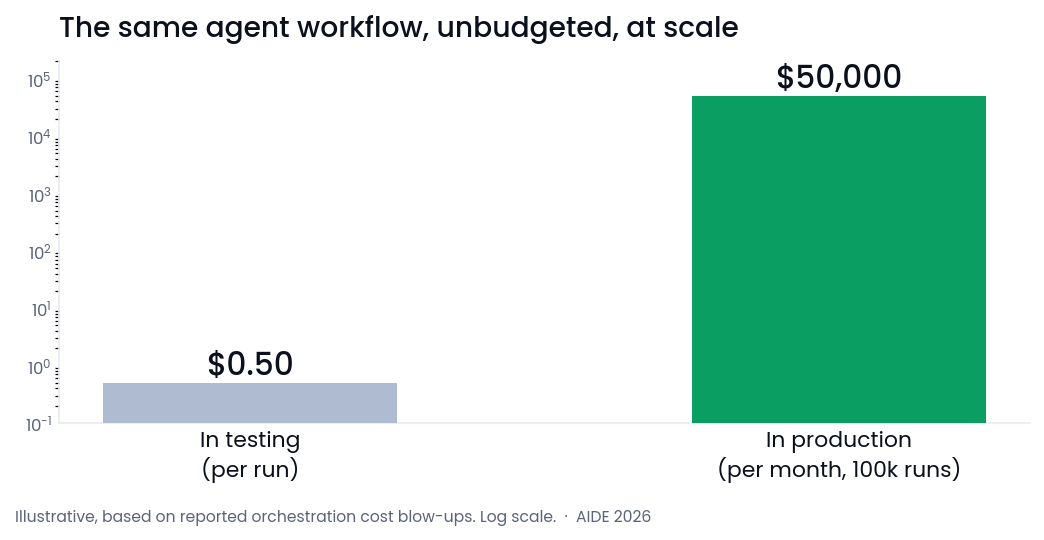
Agents loop. Without an explicit stop condition and a spend budget, a retry storm or an unbounded planning loop will run until something external kills it — and the bill arrives later.
› DATA
The same agent workflow, unbudgeted, at scale
A workflow that is trivial in testing can become a five-figure monthly bill at production volume.
4. Shipping the demo instead of the infrastructure
The demo runs once, on a good input, with a human watching. Production runs continuously, on messy inputs, unattended. Build the agent like infrastructure from day one — with logging, tracing, and alerting wired in before the first real user.
5. Giving an agent autonomy where a human belongs
Autonomy is a dial, not a switch. Let agents run freely on low-stakes, reversible steps, and insert a human approval gate on the irreversible ones. A good agent workflow reads less like a robot doing a job end to end and more like a very fast junior colleague who checks in before the decisions that are hard to undo.
The common thread
None of these five is a model problem, and none is solved by waiting for a smarter model. They are all failures of the layer around the model: how the agent is scoped, bounded, permissioned, observed, and supervised.
Sources: Digital Applied, Augment Code, Beam.ai, Medium (Allen Chan), MAS-FIRE multi-agent research (2026), and industry surveys on agentic AI as an attack vector.