
Nine in ten enterprise AI pilots never reach production. The reasons are organizational, not technical, and they are largely preventable.
The gap that defines enterprise AI in 2026
Enterprise AI has a distribution problem. The models work. The demos impress. The steering committee approves. And then, somewhere between the sandbox and the org chart, most initiatives quietly stall. The distance between a pilot that proves something can work and a production system the business can actually depend on has become the single most important dividing line in enterprise AI.
The numbers are stark and remarkably consistent across independent studies. MIT Project NANDA, in its 2025 report The GenAI Divide, found that about 95% of enterprise generative-AI pilots deliver no measurable impact on the profit-and-loss statement, with only around 5% extracting real value at scale. RAND Corporation put the failure rate at more than 80% of AI projects, roughly twice the failure rate of conventional IT projects. Analysis from Iris.ai found that 88% of pilots never reach production at all, and IDC research documented by CIO found that only four of every 33 proofs of concept graduate to wide-scale deployment.
Whichever figure you take, the conclusion is the same: for most organizations, the pilot succeeds at being a pilot and then dies before it becomes a product.
› DATA
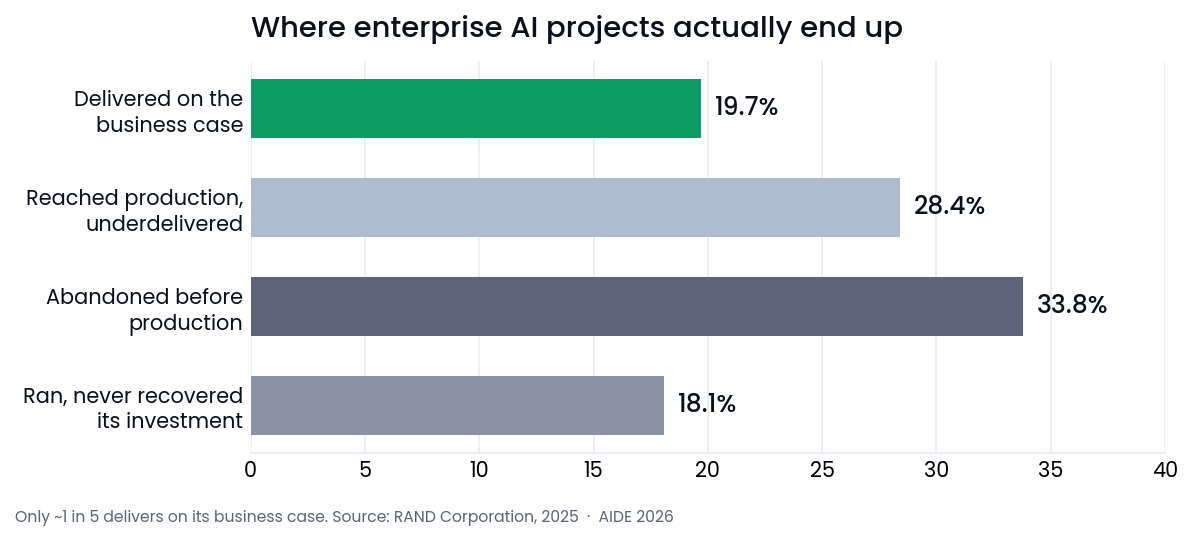
Where enterprise AI projects actually end up
The RAND breakdown is instructive because it shows that failure takes several forms. Only about 19.7% deliver on the original business case. Gartner reached a similar place from a different angle: in its April 2026 survey of 782 infrastructure and operations leaders, only 28% of AI use cases fully succeeded and met their ROI expectations.
The spending behind those outcomes is enormous. Gartner forecast worldwide generative-AI spending of roughly $644 billion in 2025, a jump of about 76% on the prior year. When the overwhelming majority of that produces no measurable return, the waste runs into the hundreds of billions.
It is not the model, it is the organization
The instinct inside AI teams is to blame the technology, or regulation, or the choice of model. The evidence points somewhere less comfortable: the failures are organizational, and they are structural. A handful of root causes recur in almost every post-mortem.
› DATA
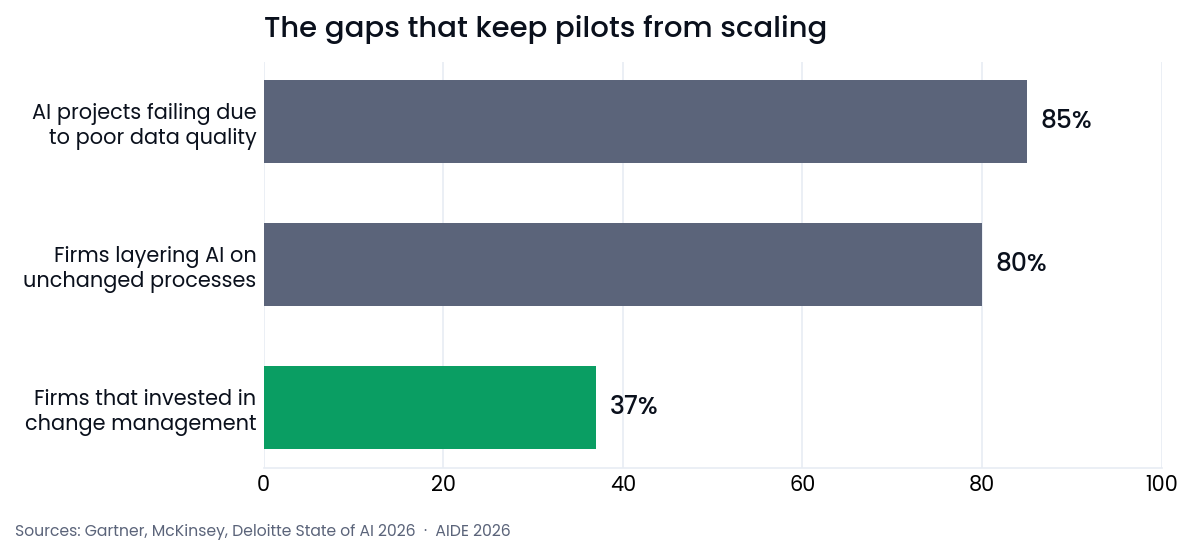
The gaps that keep pilots from scaling
- Data readiness. Gartner predicts organizations will abandon 60% of AI projects that are not supported by AI-ready data, and estimates that 85% of AI projects fail because of poor data quality. Pilots run on curated datasets that do not exist in production.
- Metrics that are never measured. One 2026 study found that 61% of AI projects were approved on projected ROI that was never measured after launch, and 42% showed zero return.
- Process debt. McKinsey research found that nearly 80% of organizations layer AI on top of existing processes without rethinking how work actually flows.
- Change-management debt. Deloitte's 2026 State of AI survey of more than 3,000 leaders found that only 37% of organizations had invested meaningfully in change management, incentives, or training alongside their AI deployments.
Pilot proliferation and the abandonment surge
› DATA
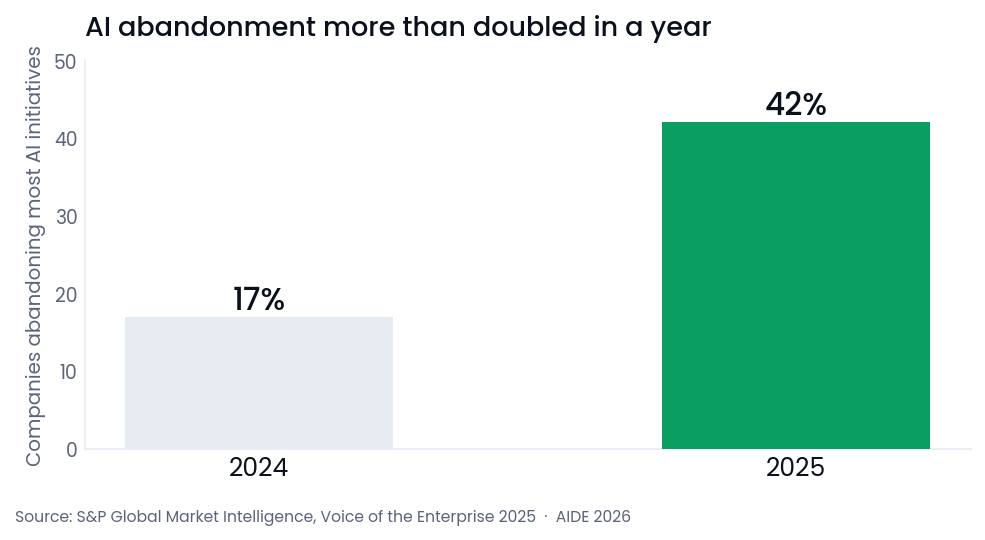
AI abandonment more than doubled in a year
The most recognizable failure pattern is launching eight to twelve pilots at once instead of two, spreading resources so thin that none builds the momentum required to cross into operations. Deloitte put the average sunk cost of an abandoned initiative at $7.2 million.
There is also a simple expectations problem. Pilots typically take six to twelve weeks. Production deployments take six to twelve months. Leaders who plan as if production is a short extension of the pilot set the initiative up to stall.
What the 5% do differently
- Define quantified success metrics before approval, and measure them after launch.
- Treat data readiness as a precondition — invest in the data foundation first.
- Redesign the workflow, not just the tool. Rebuild the process around the AI.
- Fund change management as a first-class workstream.
- Concentrate, do not proliferate. Two focused pilots beat a dozen science projects.
- Sustain sponsorship and choose build-or-buy carefully — MIT found purchased, adaptable solutions delivered more reliable results than most in-house builds.
The bottom line
The pilot-to-production gap is not an edge case. It is the norm, and it is the reason a market that has spent hundreds of billions of dollars has so little measurable profit to show for it. The failure patterns are well understood and largely preventable. The constraint was never the intelligence. It is the unglamorous, institution-specific work of wiring that intelligence into data, process, people, and governance.
Sources: MIT Project NANDA (The GenAI Divide, 2025), RAND Corporation, Gartner, Deloitte State of AI 2026, S&P Global Market Intelligence, McKinsey, IDC and Iris.ai. Current as of July 2026.