
The adoption statistics contradict each other, budgets are rising but rarely measured, and the real constraint is not money. A data-led look at where the UK mid-market stands.
Start by distrusting the headline number
Ask how many UK businesses use AI and you can get 16%, 25%, 35%, 54% or 71%, all published in the last year by credible organizations. The Office for National Statistics, the most conservative series, puts it at about 25% of all UK businesses as of late 2025, rising to 44% among firms with 250 or more employees. Before quoting any AI adoption figure, check who was actually surveyed.
A two-speed market, with a mid-market twist
UK adoption is sharply two-speed. Large firms have nearly doubled their adoption rate since 2023, reaching about 44%, while small firms have moved more slowly to around 26%. But usage intensity runs the other way: within firms that have adopted AI, about 38% of staff use it in micro firms, against 26% in small, 18% in medium, and 20% in large. Big companies adopt AI more often; small companies use it harder when they do.
› DATA
The bigger the firm, the more likely the budget grows
What the mid-market is actually budgeting
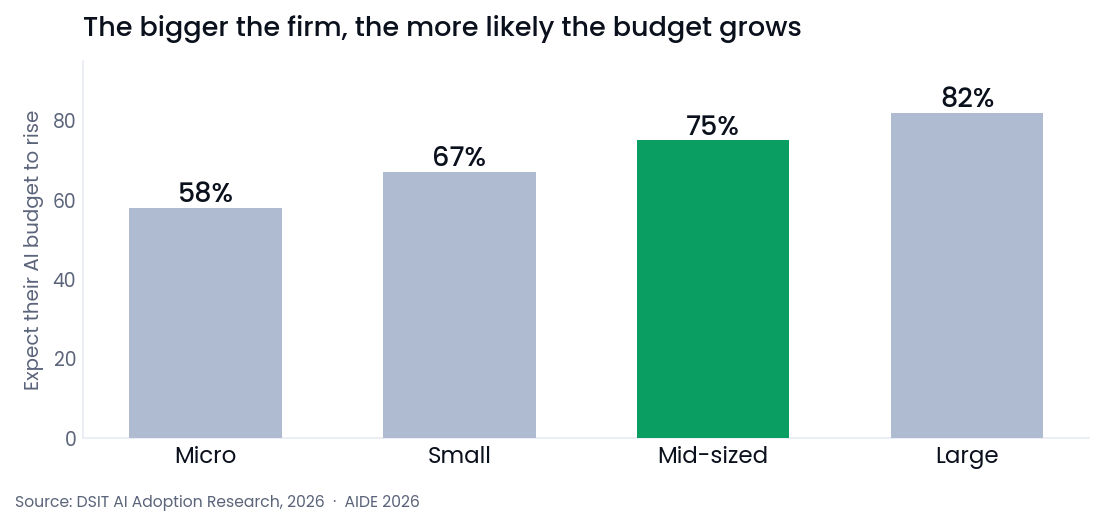
Across UK organizations, 85 to 91% report increasing their AI budgets year on year. Benchmark data puts average annual AI spend for SMEs at roughly £2 to £8 million, against £45 to £78 million for large enterprises, and forecasts total UK addressable AI spend growing from about £18.2 billion in 2025 to £31.4 billion by 2028.
The more revealing number is how little of this is planned. Among firms intending to adopt AI in the coming year, 47% had set no specific budget at all, and a further 25% did not know how much was budgeted.
› DATA
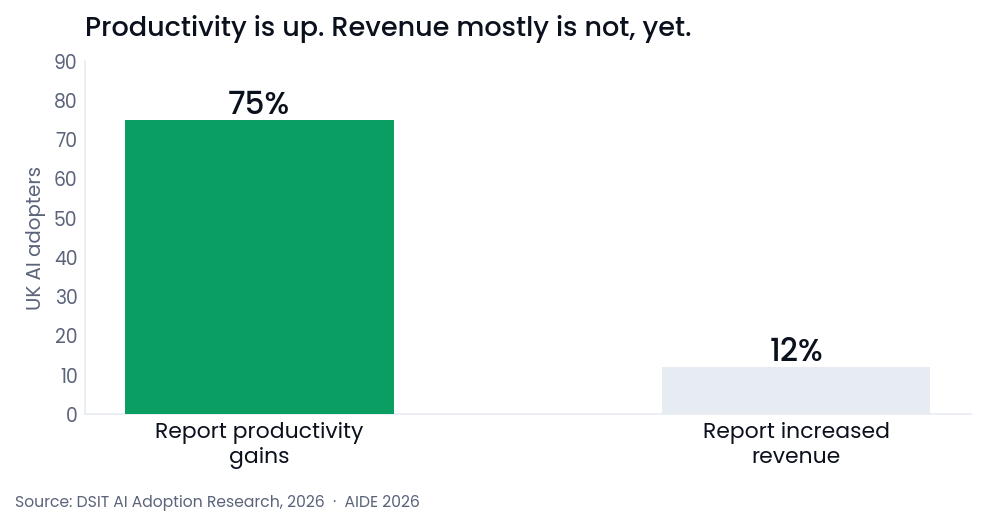
Productivity is up. Revenue mostly is not, yet.
The real constraint is not money
› DATA
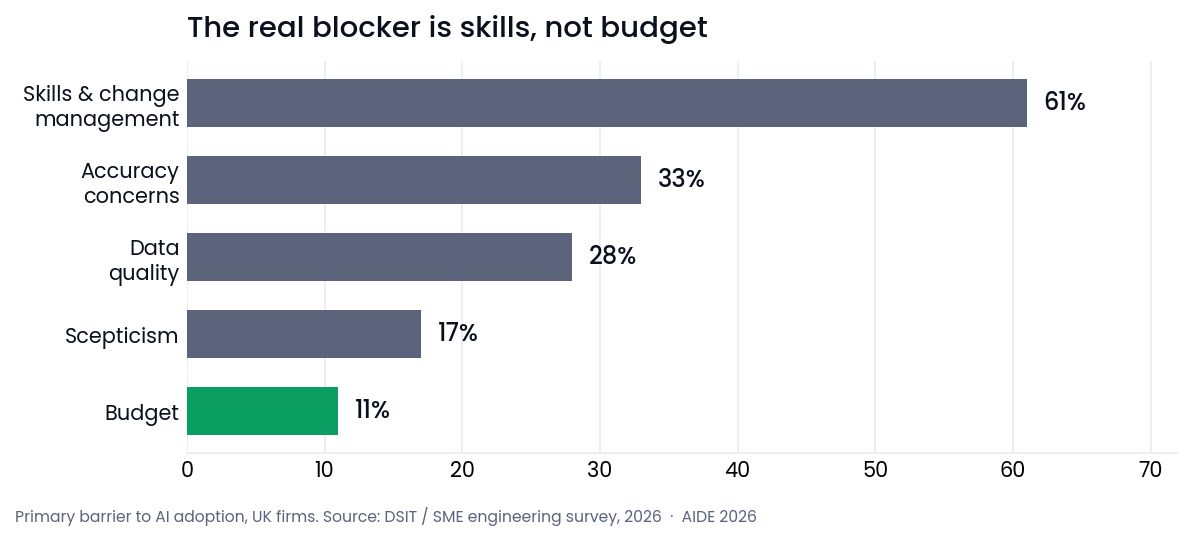
The real blocker is skills, not budget
Government research found 71% of businesses had not identified a clear use for AI, and that limited skills and expertise, not limited funds, was the key blocker. Buying more tools does not fix a skills-and-strategy gap; it widens it.
What the numbers tell a mid-market leader to do
- Budget for outcomes, not tools. Tie every spend to a named business result and measure it after launch.
- Fix the skills and strategy gap first. Fund training and a small number of clearly-owned use cases.
- Invest in data readiness — usually the highest-return investment for a mid-market firm.
- Concentrate spend where usage is deep. Avoid thin AI spread across a big headcount.
- Set realistic payback horizons — two to four years on serious programmes.
- Treat governance as a growth lever. The 7% with a defined, governed strategy see the returns.
The bottom line
The UK mid-market is not short of AI ambition or, increasingly, of budget. It is short of the discipline that turns budget into return: clear use cases, the skills to run them, the data to feed them, and the patience to measure them properly.
Sources: UK Office for National Statistics, DSIT AI Adoption Research (2026), British Chambers of Commerce, FSB, Helium42 UK AI Adoption Benchmark 2026, Gartner 2026 CMO Spend Survey.