As autonomous agents move into production, the old AI governance playbook breaks. Here is the model that actually works.
The governance problem nobody scoped for
AI agents changed the risk equation. A chatbot answers a question; an agent takes action. It holds credentials, calls tools and APIs, moves across systems, and makes decisions with real-world consequences — often thousands of small ones an hour. That autonomy is exactly what makes agents valuable, and exactly what makes them hard to govern with the controls most enterprises have in place.
› DATA
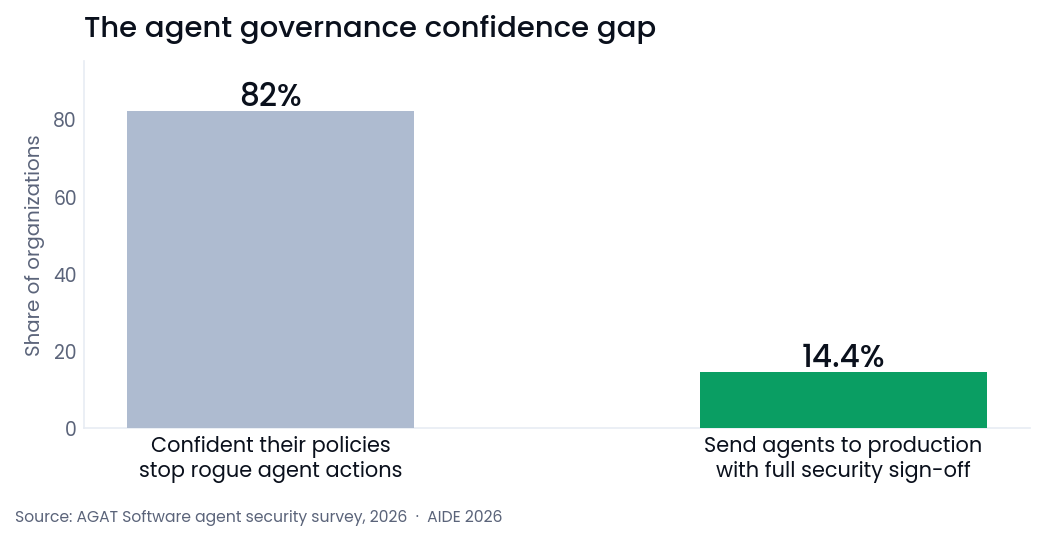
The agent governance confidence gap
The AvePoint 2026 State of AI report found that 88.4% of organizations had experienced at least one agent-related security incident in the past year, alongside a sharp rise in unsanctioned, shadow agent use.
Why agents break traditional governance
- Autonomy and cascading failure. Analysts estimate each agent can expand the network attack surface by more than 400% relative to a human user.
- Identity, not software. An agent is an actor with credentials — a machine-scale identity, not a feature inside an application.
- Attribution gaps and scope creep. Who owned this agent, what was it allowed to do, and who is accountable for what it did?
The framework landscape, and its blind spot
| Framework | What it is | Where it fits |
|---|---|---|
| NIST AI RMF 1.0 | Voluntary US risk framework built on four functions: Govern, Map, Measure, Manage | Your internal operating model for managing AI risk |
| ISO/IEC 42001:2023 | The first certifiable international AI management-system standard | Third-party proof of governance for customers and procurement |
| EU AI Act | Binding EU law, risk-tiered, enforcement beginning August 2026 | The legal requirement for any AI that reaches EU users |
| Singapore Model AI Governance Framework | Updated January 2026, risk-proportional oversight | The first framework to address autonomous agents directly |
| NIST AI Agent Standards Initiative | Launched February 17, 2026 by NIST CAISI | Emerging agent-specific security and interoperability standards |
None of the major frameworks was originally designed for agentic AI. Stack them rather than run them as separate compliance exercises: OECD principles as the values statement, NIST AI RMF as the operating model, ISO 42001 as the certifiable proof, and EU AI Act conformity as the legal layer.
The practical model: govern every agent like an identity
› DATA
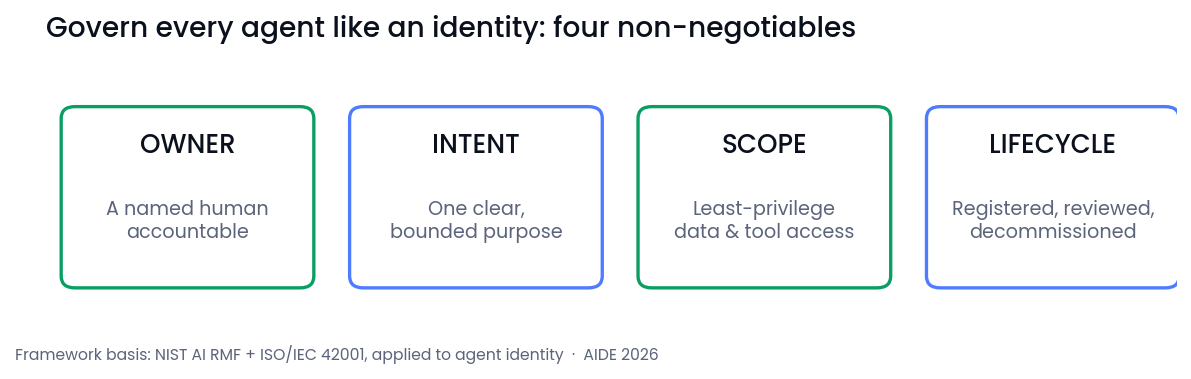
Govern every agent like an identity — four non-negotiables
- Owner. Every agent has a named human accountable for it. No orphan agents.
- Intent. Every agent has one clear, bounded purpose, documented before it ships.
- Scope. Every agent gets least-privilege access to data and tools, and nothing more.
- Lifecycle. Every agent is formally registered, reviewed on a schedule, and decommissioned when it is no longer needed.
On top of identity sits the control plane: runtime enforcement that applies policy at the protocol level so that unauthorized or destructive actions are blocked in flight rather than merely detected afterward. Prompt-injection filtering before instructions reach the model, sensitive-data redaction before anything enters context, and immutable audit records for every action.
Governance as an advantage, not a tax
Gartner has warned that more than 40% of agentic AI projects could be cancelled by the end of 2027, citing escalating costs, unclear value, and inadequate risk controls. The agents that survive that cull will be the ones that were governed like the powerful, autonomous actors they are, from the first day they were deployed — rather than the day after the first incident.
Sources: NIST (AI RMF and February 2026 AI Agent Standards Initiative), ISO/IEC 42001, EU AI Act, Singapore Model AI Governance Framework, Cloud Security Alliance, OWASP, AGAT Software, AvePoint State of AI 2026, Cisco, Gartner.